



Behind every high-performing electroplating process is a network of support systems that determine whether a line runs efficiently, safely, and profitably.
Among the most critical of these are heating and pumping systems, long considered necessary but often overlooked in innovation.
That is beginning to change. As operating costs climb and shops are forced to scrutinize every aspect of production, companies like Ronatec are introducing new approaches that challenge decades of conventional thinking. At the center of that evolution are micro-boiler systems and reengineered pump technologies that promise significant gains in efficiency, installation speed, and long-term reliability.
According to Ronatec President Jim Wetherald, the shift is already well underway.
“Micro boiler technology is definitely the future for several reasons,” he says.
Breaking Away from Traditional Boiler Systems
 For years, electroplating facilities relied on large, centralized boilers to heat their operations. These systems were typically oversized to handle peak demand and often installed in redundant configurations to ensure uptime. While effective, they came with substantial drawbacks—high capital costs, complex permitting requirements, and ongoing maintenance burdens.
“Those are great, but they’re expensive,” Wetherald says. “They require a lot of permitting, they’re heavy on maintenance, and very expensive to install.”
Installation alone could be a major undertaking. Heavy steel piping systems required threading or welding, often stretching project timelines into months. Even after installation, facilities were subject to inspections that varied by jurisdiction—monthly, quarterly, or annually—depending on boiler size and local regulations.
It was during a project overseas that Wetherald first encountered an alternative that would reshape Ronatec’s approach.
“I came across this micro boiler technology, and it just blew my mind,” he recalls. “I said, ‘There must be some language barrier here, because that doesn’t look like a boiler.’”
Compact Design, Industrial Performance
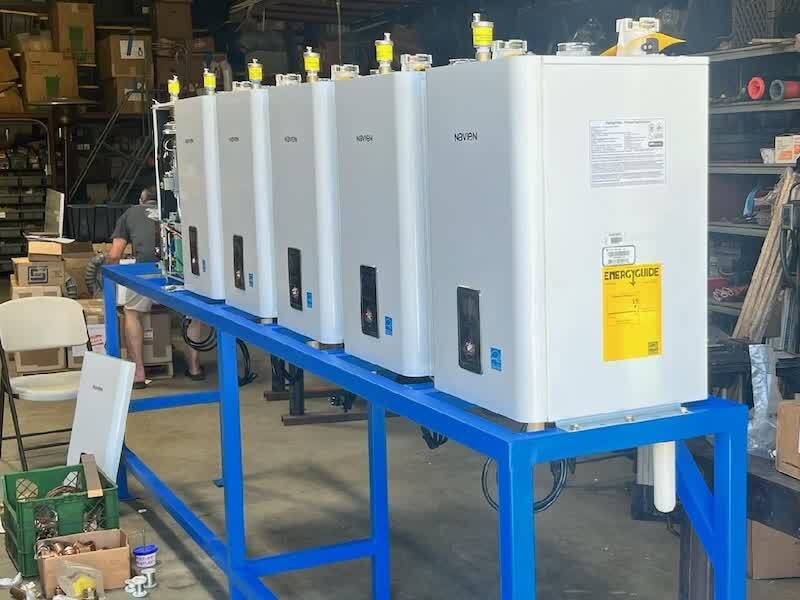
 What initially seemed unconventional quickly proved to be transformative. Micro boilers, roughly the size of a carry-on suitcase, deliver powerful performance through modular design. Instead of relying on one or two large units, multiple small boilers can be stacked together to achieve the required output.
“These units can have up to 20 units stacked on each other, each one doing 199,999 BTUs,” Wetherald says. “When we stack that many, I’m actually getting a 4 million BTU boiler system without the issues.”
That “without the issues” is key. By operating just below permitting thresholds, these systems avoid many of the regulatory requirements associated with traditional boilers, reducing both administrative burden and long-term compliance costs.
The modular approach also enables advanced energy management. Built-in sequencing mimics the lead-lag functionality of traditional systems but with far greater precision.
“If the loop is bringing the water back at that temperature, the mother turns off her children,” Wetherald says. “You can imagine the energy efficiency you’re getting.”
The results are striking.
“These things are so energy efficient that even though they’re putting out 192° Fahrenheit hot water, the exhaust is 71°Fahrenheit,” he says. “It’s near 99% energy efficient.”
Speed and Simplicity in Installation
Beyond performance, one of the most compelling advantages of micro boiler systems is their quick installation. Traditional boiler installations often require months of labor, particularly when large-diameter steel piping is involved.
Micro boiler systems, by contrast, can be installed using CPVC piping, dramatically simplifying the process.
“I can just cut, glue, and rock and roll,” Wetherald says. “Instead of taking me two months, we’re doing this in days.”
“I would say 90% of what we build, if they’re going boiler heat, they are going the micro.”
This accelerated installation timeline is especially valuable for new line builds, where time-to-production is critical. In many cases, piping can be pre-installed on the line before it arrives on-site, allowing for rapid assembly and commissioning.
Cost savings follow naturally, as Wetherald says shops are looking at about 60% less than a traditional boiler system.
Addressing High-Temperature Applications
Despite their many advantages, micro boilers are not a universal solution. Their operating limits typically cap process temperatures below what is required for certain applications.
“We can really only get a process tank up to about 168° to 170° Fahrenheit,” Wetherald notes. “This doesn’t work for electroless nickel or black oxide.”
To address this, Ronatec often implements hybrid systems that combine micro boilers with supplemental heating.
“We use a micro boiler system on most of the tanks, and then we use an electric booster heater system to get those other tanks up,” he says.
“The cost savings are huge. A lot of people are saying, ‘Wow, that’s too good to be true.’ But with the number of these systems we have out there, it’s such a proven technology now.”
In addition, newer high-output micro boiler designs are expanding the technology’s range.
“We actually have a new micro boiler technology putting out about 500,000 BTUs at 230° degrees Fahrenheit,” Wetherald says, noting that these units can be strategically located near high-temperature tanks to minimize piping complexity.
Proven Reliability and Growing Adoption
While micro boilers may still sound novel to some, Wetherald emphasizes that the technology is well proven in the field.
“Out of those 300 or so units, I’ve only had one issue with a $50 screen. Other than that, I haven’t had one go out,” he says.
That reliability, combined with cost and efficiency advantages, is driving widespread adoption.
“I would say 90% of what we build, if they’re going boiler heat, they are going the micro,” he adds.
Even initial customer skepticism tends to fade once they see the numbers.
“The cost savings are huge,” Wetherald says. “A lot of people are saying, ‘Wow, that’s too good to be true.’ But with the number of these systems we have out there, it’s such a proven technology now.”
Rethinking Pump Technology
 Heating may be the backbone of a plating line, but fluid movement is its lifeblood. Here, too, Ronatec is challenging traditional approaches.
“I’m a big proponent of horizontal mag drive pumps versus vertical pumps,” Wetherald says.
Vertical pumps, commonly mounted directly in tanks, are exposed to harsh chemical environments and corrosive fumes. Over time, this exposure can significantly shorten their lifespan.
“There’s no point in having it in there, and it’s breathing all those fumes… the pumps only last a year,” he explains.
By relocating pumps outside the tank and using magnetic drive technology, Ronatec improves both durability and maintenance accessibility.
“The advantage with a mag drive is we mount that towards the bottom of the tank, so it’s always got that flooded suction,” he says.
This configuration also eliminates priming issues—a frequent cause of pump failure.
“If your solution level drops… there’s a chance that impeller’s going to run dry… that’s a $4,500 mistake,” Wetherald notes.
Overcoming Challenges in Electroless Nickel
Mag drive pumps, however, present a unique challenge in electroless nickel applications, where plating can occur on internal magnetic components.
“For electroless technology, you want to avoid mag drive pumps because… the electroless nickel is going to plate out on the magnet inside the pump,” he explains.
To solve this, Ronatec has begun implementing a specialized dual-seal pump system that isolates the magnetic components using a pressurized barrier.
“What they’re doing is putting a pressurized water source in between a dual seal so that the magnet is isolated, and it’s so cool,” Wetherald says.
Early results have been promising. “I’ve got five of them out there right now, and we’re having great success with them.”
The company is already working on further refinements, including backup systems that use compressed air to maintain seal integrity.
A New Focus on Total Cost of Ownership
Perhaps the most significant shift Wetherald is seeing in the market is how customers evaluate new systems. It’s no longer just about the upfront cost of equipment—it’s about the cost to operate over time.
“The number one thing I’m getting asked right now… is not just what’s the cost of the line, but how much is it going to cost me to run a day,” he says.
That includes energy consumption, chemical usage, labor requirements, and permitting costs.
“There’s a whole new element of cost expenditure that we have to look at now… literally everything is costing double to operate right now than it did three years ago.”
This broader perspective is driving interest in technologies that deliver measurable efficiency gains without sacrificing performance.
Despite the increasing role of automation and advanced systems, Wetherald is quick to point out that the goal is not to replace workers, but to make their jobs more efficient.
“It’s not replacing jobs, but making someone’s job a little more efficient,” he says. “Instead of them spending two hours doing this, now it’s 30 minutes.”
Visit https://ronatec.us.